Plantin-Moretus: a printing house you can walk round
Antwerp, Belgium
A printing house that worked for three centuries on the Vrijdagmarkt, with its presses, type, books and family portraits by Rubens still in place. A World Heritage site, timed for one hour.
- About an hour
- Check the museum's free hours
- First: The printing room and its presses
Same room: Museum Mayer van den Bergh · Red Star Line Museum
When the doors are free · Every label in one list
Best months Spring and autumn · Getting there Walk from the Groenplaats or the Grote Markt · Bring Reading glasses for the small print
Christophe Plantin was a French bookbinder who settled in Antwerp in the 1540s and became one of the great printers of the sixteenth century. His firm, under the sign of the Golden Compasses, printed Bibles, maps, scientific books and the work of humanists across Europe. After his death in 1589 the business passed to his son-in-law Jan Moretus, and the Moretus family kept printing in the same house for nearly three centuries. In 1876 the city of Antwerp bought the house with its contents, and it opened as a museum the following year. In 2005 it was added to the UNESCO World Heritage list.
What makes it remarkable is that so much survived together: the house, the workshops, the presses, the type, the archive, the library and the family's pictures. You walk through a working business and a family home at the same time.
Plantin chose a pair of compasses held by a hand from the clouds as his mark, with the motto Labore et Constantia, by labour and constancy: the fixed point of the compass for constancy, the moving point for labour. You will see it carved, painted and printed all over the house, on title pages, over doorways and on the façades in the courtyard. It is worth knowing before you start, because finding it becomes a small game as you walk round.
Antwerp in Plantin's time was one of the richest cities in Europe and a centre of trade, banking and printing. The firm's books travelled across the continent, and its workshop drew scholars, engravers and type cutters from many countries. The house you visit grew with the business, room by room, over several generations.
The Vrijdagmarkt front and the courtyard
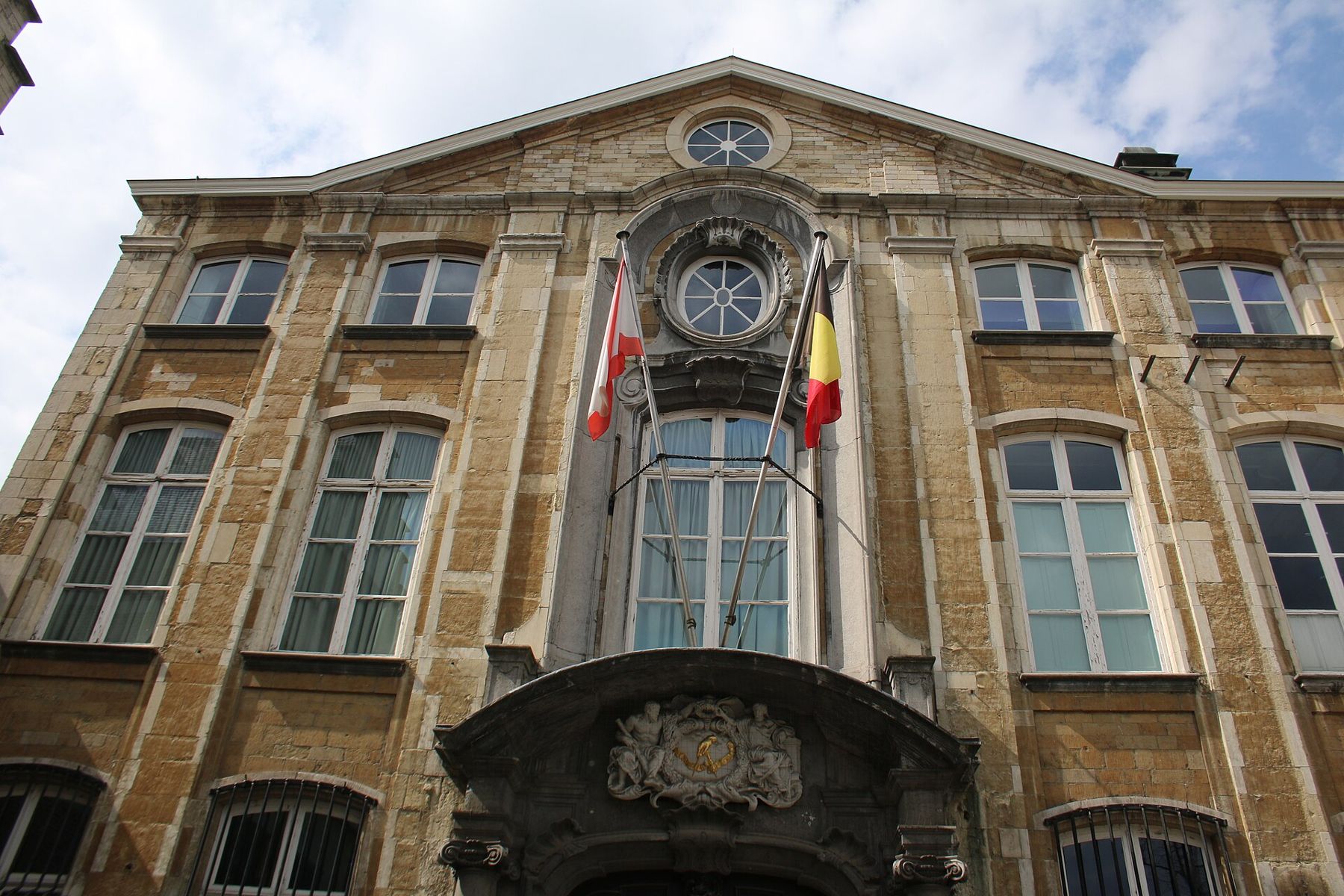
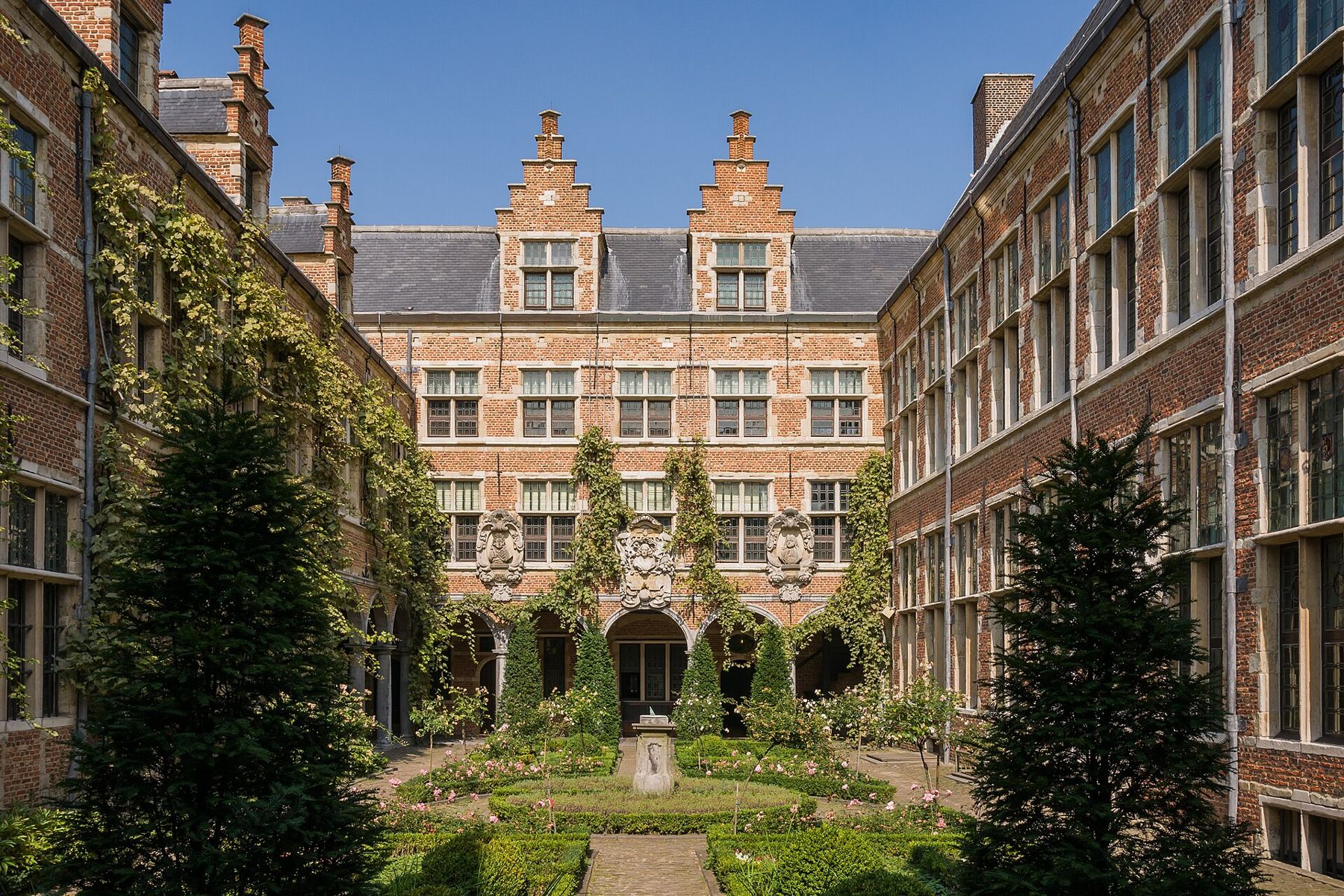
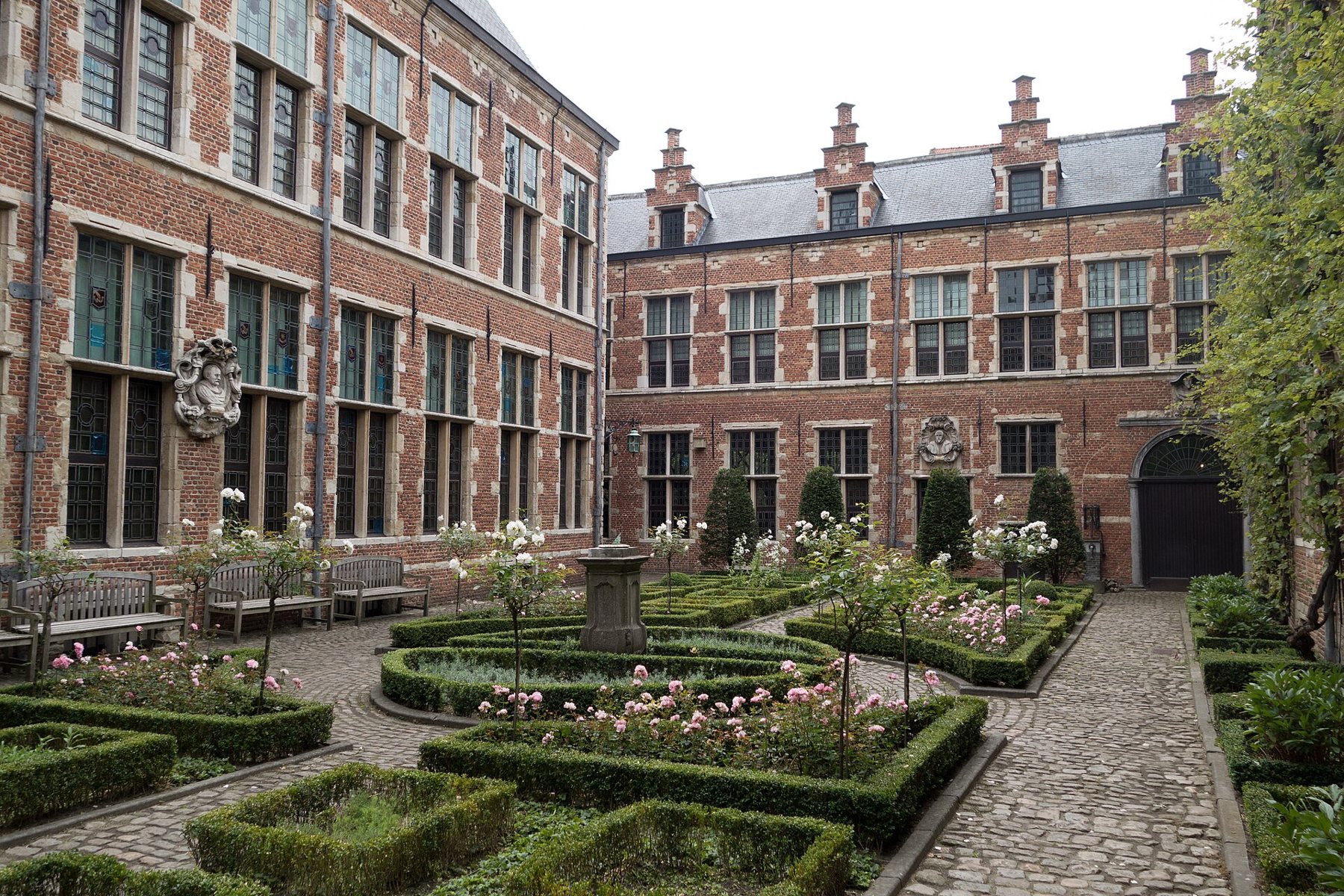
The museum faces the Vrijdagmarkt, a small square a few minutes south-west of the Grote Markt, where second-hand goods have been sold for centuries. The street front is a calm eighteenth-century façade, but it is only a mask. Inside, the buildings wrap round a courtyard garden, with brick walls, stepped gables, climbing plants and stone busts set into the walls.
Look into the courtyard early, then again at the end. It is the clearest view of the house as a whole, and on a fine day it is one of the quietest places in the old town.
Presses, type and the people who set it
The printing room is the heart of the visit. It holds the two oldest surviving printing presses in the world, dating from around 1600, together with later presses and the type cases where compositors picked letters one at a time. Stand by the presses and imagine the noise. Several machines ran together here, ink was beaten onto the type, and printed sheets hung overhead to dry.
Stand by the presses and imagine the noise.
Nearby is the type foundry, where letters were cast in metal, and the collection of punches and matrices, the steel and copper tools used to make type. This is one of the most important collections of its kind anywhere, and it explains how a printer could produce books in Latin, Greek, Hebrew and other scripts. Among the punches are letters cut by Claude Garamond and Robert Granjon, two of the most influential type designers of the sixteenth century, whose shapes still echo in typefaces used today. Then find the proof-readers' room, a small panelled room by a window, where scholars checked pages before they were printed. A desk, books and papers are laid out as though work had just stopped.
No. 08 · Next roomMuseum Mayer van den BerghAntwerp, Belgium · About an hourBooks, maps and the Polyglot Bible
Upstairs, the rooms show what the presses made. The great project of Plantin's career was the Polyglot Bible, printed in several volumes with parallel texts in Hebrew, Greek, Latin, Aramaic and Syriac, under the patronage of Philip the Second of Spain. Copies are on show, along with maps, atlases, botanical books and the delicate engraved title pages that made the firm's books so admired.
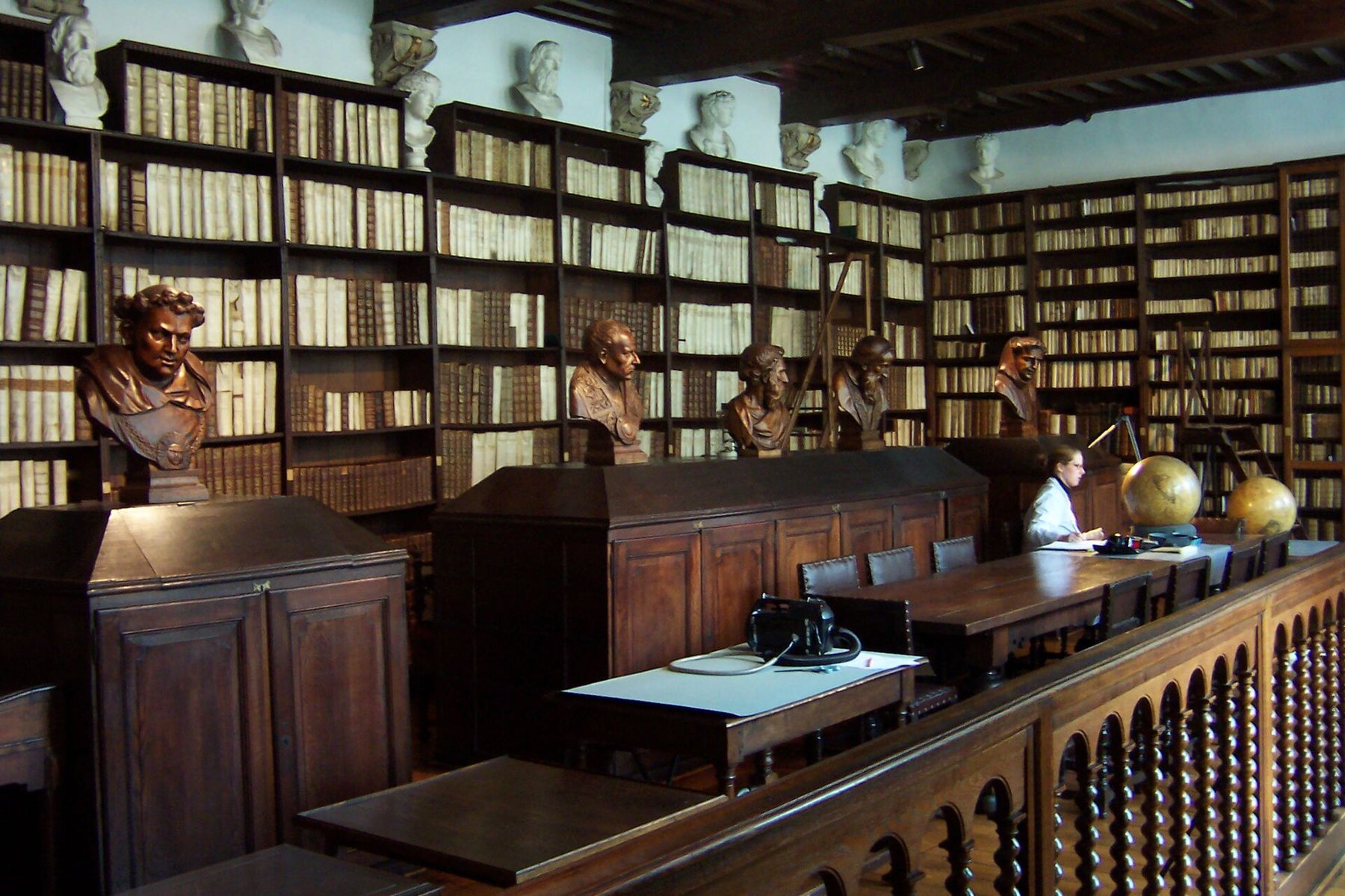
The library, with its shelves of leather bindings and old wooden fittings, is the room most visitors remember. Do not try to read everything in the cases. Pick a single book, a single map or a single page of type and look at it closely.
Much of the firm's business archive also survives: account books, letters, contracts and inventories covering centuries of work. Only a little is on show at any time, but it is the reason historians know so much about how the house ran, who worked here, what they were paid and which books sold. The displays draw on it, and the small details they quote, about wages, customers and paper, bring the rooms to life.
Rubens and the Moretus family rooms
The Moretus family were rich, educated and well connected, and the living rooms show it, with gilded leather on the walls, fine furniture and paintings. Balthasar Moretus, Jan's son, was a friend of Peter Paul Rubens from their school days, and Rubens designed title pages for the firm and painted portraits of the family and of Plantin himself. These portraits hang in the house where their subjects lived and worked, which gives them a weight they would not have in a gallery.
An hour through the house
- Five minutes in the courtyard.
- Fifteen minutes in the printing room and type foundry.
- Ten minutes in the proof-readers' room.
- Fifteen minutes with books, maps and the library.
- Ten minutes with the Rubens portraits and the family rooms.
- Five minutes back in the courtyard.
If you have more than an hour, the most rewarding extra is simply to slow down in the printing room and the type foundry. Few places anywhere let you stand so close to the tools of early printing, in the rooms where they were used, and the longer you look, the more the process makes sense: punch, matrix, type, page, press, book.
What you can leave: the house is larger than it looks, and the upper rooms of prints and drawings, and the temporary exhibitions, can wait for another visit. The audio guide is good but long, so use it in two or three rooms only.
Entry is paid, with reductions for some visitors, and arrangements change, so check before you go. Antwerp's city museums sometimes offer free entry at set times, but check the details rather than relying on them. There are many stairs and some uneven floors.
From the Vrijdagmarkt, it is a short walk to the cathedral and the Grote Markt, or east past the Meir to the Museum Mayer van den Bergh, another collector's house with one great painting by Bruegel. On the Scheldt to the north, the Red Star Line Museum tells a later Antwerp story, of emigration across the Atlantic. For another house shaped by one maker's work, the Sir John Soane's Museum in London is worth the comparison.