Museum Mayer van den Bergh and its one great painting
Antwerp, Belgium
A town house built as a museum to hold one collector's treasures, with Pieter Bruegel's Dulle Griet as its centre and small rooms of medieval sculpture, manuscripts and painting around it.
- About an hour
- Check the museum's free hours
- First: Bruegel's Dulle Griet
Same room: Plantin-Moretus Museum · Red Star Line Museum
When the doors are free · Every label in one list
Best months Any month, weekday mornings · Getting there Walk from the Meir or Rubens House · Bring Patience for a crowded painting
Fritz Mayer van den Bergh was an Antwerp collector who gathered medieval and Renaissance art with great energy and good judgement in the last decades of the nineteenth century. He died young, in 1901. His mother, Henriëtte, then had a house built to hold his collection and to keep his name, in the style of a sixteenth-century Antwerp town house, and opened it as a museum soon after. It is still run as one, close to the busy shopping streets but entirely separate from them in mood.
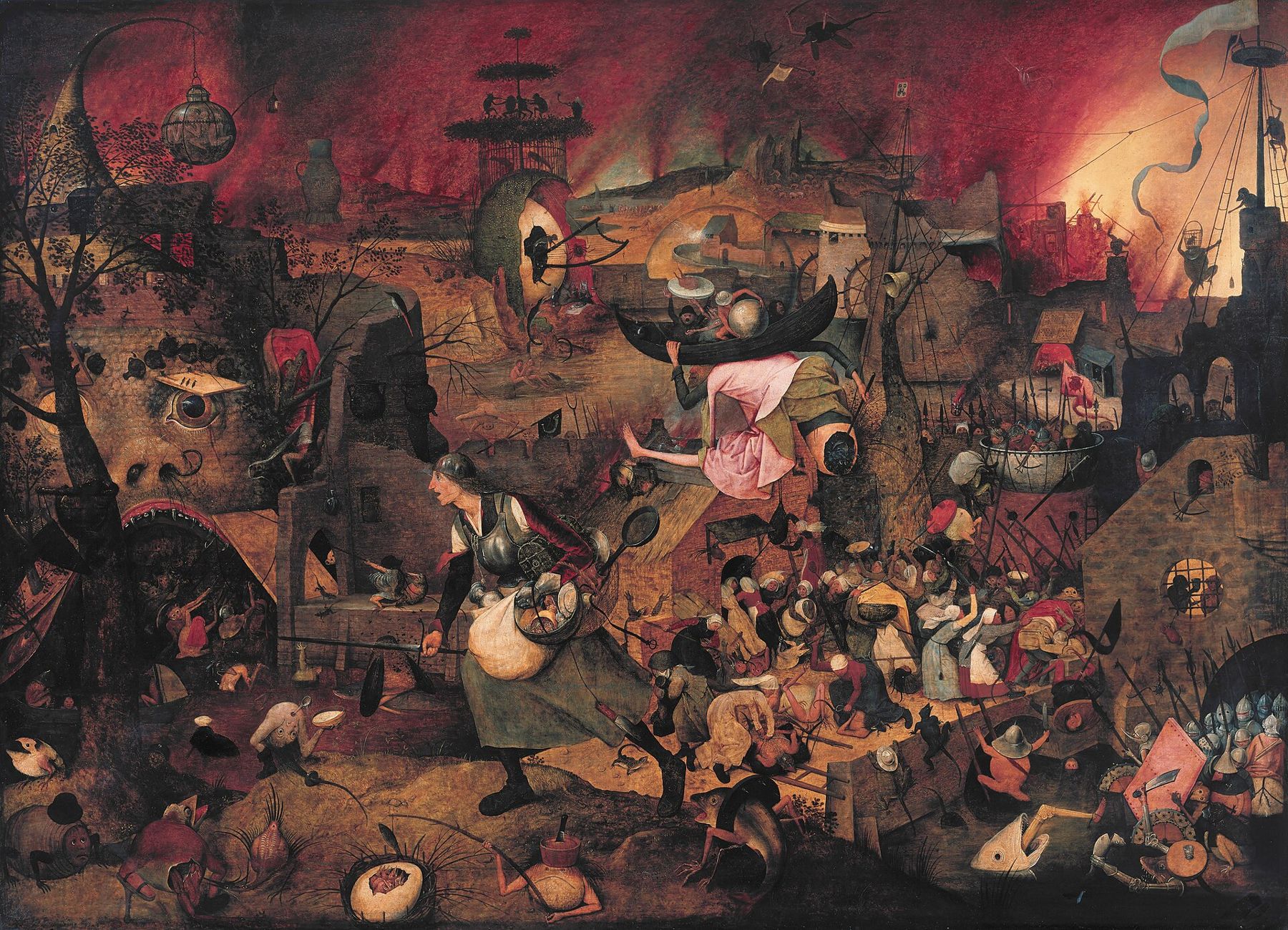
The museum is known above all for one painting, Pieter Bruegel the Elder's Dulle Griet, often called Mad Meg in English. But the rooms around it hold far more than most visitors expect, and an hour lets you do both.
Fritz bought Dulle Griet in the 1890s, at a time when its attribution was less settled than it is now. He had an eye for works others had overlooked, and much of what you see here was bought in that spirit, piece by piece, by a collector who studied as much as he spent.
A house built to look old
From the street, the museum looks like a much older building, with brick, stone dressings and tall windows. That is the effect Henriëtte wanted. Inside, rooms are panelled and furnished like a collector's home, with fireplaces, beams and display cases set among chairs and chests, rather than the bare white rooms of a modern gallery.

The scale is domestic, the rooms small and sometimes dim to protect the objects. Move slowly and let your eyes adjust in each room.
Dulle Griet, close up
Go first to Dulle Griet. A tall woman in armour and an apron strides across a burning, monstrous landscape, sword in hand, carrying a basket of plunder, while behind her a crowd of women raids a house and strange creatures swarm on every side. It is a painting of greed, folly and chaos, full of figures drawn from Flemish proverbs and from the world of Hieronymus Bosch, and painted in the early 1560s.
The panel is large enough to read from a distance, but it rewards close looking more than almost any painting of its size. Spend ten minutes on it. Start with Griet herself, then the women behind her, then the giant figure with a boat on its back, then the details in the corners. Each pass reveals something new, and the colours, all reds, browns and fire, are more intense in the room than in any reproduction.
Bruegel worked in Antwerp before moving to Brussels, and the painting belongs to the city's great age as a centre of art and printing. Nobody agrees entirely on what it means. It may mock greed, or women, or the madness of the age, or all of these at once, and the uncertainty is part of why it holds people for so long. Read the panel beside it, then look again without it.
No. 07 · Next roomPlantin-Moretus MuseumAntwerp, Belgium · About an hourThe museum also holds a second work by Bruegel, the Twelve Proverbs, a set of small painted roundels each illustrating a saying. They make a good companion to Dulle Griet and show the painter's humour on a smaller scale.
Medieval sculpture and small treasures
Fritz Mayer van den Bergh's real passion was the Middle Ages, and the rest of the house shows it. There are carved wooden figures of saints and of the Virgin, painted panels from the Low Countries, ivories, enamels, illuminated manuscripts, silver, and textiles. Many pieces are small and meant for private devotion.
Look out for the medieval sculptures of Christ and Saint John, a tender subject in which the young apostle rests his head on Christ's shoulder, and for the illuminated books shown in cases. These are the pieces the collector valued most, and they show a taste formed long before the Middle Ages were fashionable.
Many of the painted panels are by artists whose names are lost, known only by the works themselves. Do not let that put you off. Some of the small altarpieces and devotional panels are of very high quality, and their gold grounds and bright colours are well served by the low light of the house.
Sixty minutes in small rooms
- Five minutes outside and in the entrance rooms.
- Fifteen minutes with Dulle Griet and the Twelve Proverbs.
- Twenty minutes with the medieval sculpture and painting.
- Ten minutes with manuscripts, ivories and silver.
- Ten minutes back with Dulle Griet, which looks different the second time.
What you can leave: the later furniture and decorative pieces are fine but less special. If time is short, skip them and go back to the painting.
Small rooms, careful timing
Because the rooms are small, the museum can feel crowded when a group arrives, and the space in front of Dulle Griet fills quickly. Weekday mornings are usually calmer. Entry is paid, with reductions for some visitors, and arrangements change, so check before you go. There are stairs between floors.
Around the Meir and the Rubens House
The museum is a few minutes' walk from the Meir, Antwerp's main shopping street, and close to the Rubens House on the Wapper, the painter's home and studio. The cathedral and the Grote Markt are further west, and beyond them the Vrijdagmarkt and the Plantin-Moretus Museum, a printing house with portraits by Rubens.
For another collector's house that keeps its arrangement, the Wallace Collection in London is grander but similar in spirit. In Antwerp's old docklands, the Red Star Line Museum tells the story of the emigrants who left the city for America.